Back
Government

LLNL Deputy Director Pat Falcone receives inaugural AI Honors in Public Science Award
Lawrence Livermore National Laboratory (LLNL) Deputy Director for Science and Technology Patricia Falcone was presented with the AI Honors in Public Science award at the inaugural AI Honors Gala on June 3 at the Waldorf Astoria Hotel in Washington, D.C. Coinciding with the AI+ Expo at the Walter E. Washington Convention Center, the AI Honors Gala convened more than 300…

U.S. Energy Secretary Wright visits Lawrence Livermore National Laboratory
U.S. Secretary of Energy Chris Wright today visited Lawrence Livermore National Laboratory (LLNL) to see firsthand the Lab’s vital contributions to national security and advancing America’s scientific and technological leadership. Secretary Wright met with top Lab leaders, including LLNL Director Kim Budil, and participated in an all-hands meeting with Lab employees…

LLNL leadership engages in global fusion energy efforts
Lawrence Livermore National Laboratory (LLNL) leadership is engaging with world leaders to make fusion energy a reality. Last week, LLNL Director Kim Budil joined the International Atomic Energy Agency’s (IAEA) inaugural meeting of leading fusion energy experts and high-level policymakers from 35 countries in Rome. “In the face of growing global competition and a…

LLNL and BioVind achieve diagnostics milestone
Technology designed to aid on-the-field diagnostics for military applications is gaining a wider reach as Lawrence Livermore National Laboratory (LLNL) and BioVind, LLC achieved a milestone in their partnership: the exclusive licensing of LLNL pathogen diagnostics technology focused on oil and gas applications. The technology, called BioID, is a rapid and portable…

LLNL summer programs: inspiring future opportunities for students
This summer, Lawrence Livermore National Laboratory (LLNL) hosted several science education programs that provided students with hands-on experience related to several LLNL research themes. The science education offerings for this summer included three standout programs: STEM with Phones, the Biotech Summer Experience and the Manufacturing Workshop. The Manufacturing…

LLNL signs MOU with Korean research institution to explore hydrogen and low-carbon technology
Leaders from Lawrence Livermore National Laboratory (LLNL) and the Korea Advanced Institute of Science and Technology (KAIST) recently signed a memorandum of understanding (MOU), as they seek to expand collaborations related to their shared research interests in hydrogen and other low-carbon energy technology. The two institutions have engaged in informal collaborations…

All ears on the Big Ideas Lab podcast
Lawrence Livermore National Laboratory (LLNL) has big ideas and is showing the world in the Big Ideas Lab weekly podcast that takes listeners behind the fences and into its heart. “This is where big ideas come to life,” said Lab Director Kim Budil. “To do this, we bring together dynamic teams of many different disciplines — laser physicists and materials scientists and…

LLNL wins three 2024 technology commercialization grants
Lawrence Livermore National Laboratory (LLNL) researchers continue to capture key Department of Energy (DOE) Technology Commercialization Fund (TCF) grants with three new project grants announced in 2024. This year’s TCF program focuses on funding projects aimed at delivering clean energy solutions to the market — using new technology commercialized from DOE national labs…

Two LLNL physicists honored for international collaboration
Lawrence Livermore National Laboratory (LLNL) physicists Hye-Sook Park and George Swadling, along with Anna Grassi of France’s Sorbonne University and former Lawrence Fellow Frederico Fiuza of Portugal’s Técnico Lisboa, received the 2024 Lev D. Landau and Lyman Spitzer Jr. Award for Outstanding Contributions to Plasma Physics. The award is jointly sponsored by the Plasma…

Magnesium oxide undergoes dynamic transition when it comes to super-Earth exoplanets
Researchers from Lawrence Livermore National Laboratory (LLNL) and Johns Hopkins University have unlocked new secrets about the interiors of super-Earth exoplanets, potentially revolutionizing our understanding of these distant worlds. The focus of this work, magnesium oxide (MgO), a crucial component of Earth’s lower mantle, is believed to play a similar role in the…

DOE, LLNL take center stage at inaugural artificial-intelligence expo
Lawrence Livermore National Laboratory (LLNL) Director Kim Budil and other LLNL staff joined Department of Energy (DOE) Deputy Secretary David Turk, National Nuclear Security Administration (NNSA) Administrator Jill Hruby, DOE Under Secretary for Science and Innovation Geraldine Richmond, DOE Director of the Office of Critical and Emerging Technologies Helena Fu, U.S…

Finding Livermore: Employees share their LLNL origin stories
With more than 70 years of history and nearly 9,000 current employees, it is not uncommon for several generations of family members to have worked at Lawrence Livermore National Laboratory (LLNL). For those employees with parents or grandparents preceding them, a career at the Laboratory was not in their original plans. In fact, before coming to LLNL, many do not realize…

Lawrence Livermore National Laboratory to host summer career fair 2024
Lawrence Livermore National Laboratory (LLNL) empowers multidisciplinary teams to pursue big ideas using innovative science and technology to meet the national security mission and make the world a better place — and the Lab is growing every day. To recruit prospective employees for more than 150 open positions, LLNL is hosting a summer on-site career fair to share…

Jupiter Laser Facility gets a reboot
Fifty years ago, the first laser, Janus, was installed in Building 174 (renamed the Jupiter Laser Facility in 2006) at Lawrence Livermore National Laboratory. Additional lasers, more than 100 Ph.D.s granted time on the system and thousands of international users later, the Jupiter Laser Facility (JLF) celebrated its grand reopening Thursday after a four-year refurbishment,…

Lawrence Livermore honored as one of Glassdoor's 2024 'Best-Led Companies'
Lawrence Livermore National Laboratory (LLNL) has been named a winner of Glassdoor’s inaugural award for Best-Led Companies 2024 in the United States. This award honors companies with exceptional senior leadership teams that go above and beyond to redefine the employee experience. Unlike other workplace awards, Glassdoor’s awards rely on input over the past year from…
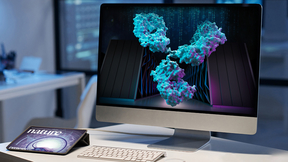
GUIDE team develops approach to redesign antibodies against viral pandemics
In a groundbreaking development for addressing future viral pandemics, a multi-institutional team involving Lawrence Livermore National Laboratory (LLNL) researchers has successfully combined an artificial intelligence (AI)-backed platform with supercomputing to redesign and restore the effectiveness of antibodies whose ability to fight viruses has been compromised by…

Lawrence Livermore National Laboratory honored as a 2024 VETS Indexes 4-Star Employer
Lawrence Livermore National Laboratory (LLNL) has been recognized as a VETS Indexes 4 Star Employer in the 2024 VETS Indexes Employer Awards. The award recognizes organizations committed to recruiting, hiring, retaining, developing and supporting veterans and the military-connected community. LLNL is one of 285 organizations recognized for 2024. See the full slate of…
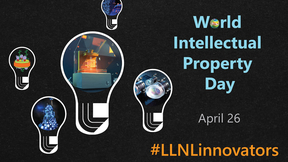
Celebrating LLNL researchers on World Intellectual Property Day
World Intellectual Property (IP) Day is Friday, April 26. World IP Day shines a light on the important role innovation plays in achieving the United Nations’ (UN) 17 Sustainable Development Goals (SDGs), which aim to create a better future for everyone by protecting the planet. Lawrence Livermore National Laboratory’s (LLNL)’s Innovation and Partnerships Office (IPO) is…
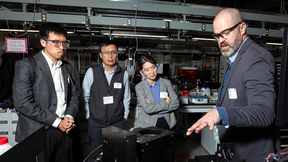
LLNL hosts Early Career Information Day focused on advanced materials and manufacturing
The University of California (UC) and Lawrence Livermore National Laboratory (LLNL) have a storied history going back to the founding of the Laboratory in 1952. The work conducted at the Lab since that time has benefited in many areas from successful collaboration with researchers and contributors within the UC system. In the spirit of continued collaboration, a UC Early…
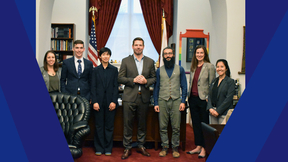
Energy I-Corps experience shines light on bringing specialty resin to the silicone 3D-printing market
In the fall of 2023, Lawrence Livermore National Laboratory (LLNL) scientists Sijia Huang and Michael Ford participated in the Department of Energy’s Energy I-Corps Program, an immersive eight-week entrepreneurial boot camp that teaches scientists and engineers the tools of the trade for commercializing technology from the Lab to the marketplace. A major part of the…