Back
Engineering

LLNL welcomes six new machinist apprentices in signing ceremony
Lawrence Livermore National Laboratory (LLNL) welcomed six new members into its prestigious machinist apprenticeship program during a signing ceremony held July 24. The event, attended by Lab leadership, supervisors and state officials, marked the official start of a four-year journey in advanced manufacturing for the new cohort. The apprentices — Ace Jenkins, John Burns,…

LLNL team tackles support structure bottlenecks with dual-wavelength 3D printing
Lawrence Livermore National Laboratory (LLNL) researchers have developed a novel 3D printing technique that uses light to build complex structures, then cleanly dissolves the support material, expanding possibilities in multi-material additive manufacturing (AM). In 3D printing, traditional supports often add time, waste and risk to the process, especially when printing…

Annual workshop brings together signal and image science community
On May 21 and 22, signal and image science experts from across LLNL, academia and industry gathered at the UC Livermore Collaboration Center (UCLCC) for the 29th annual Center for Advanced Signal and Image Sciences (CASIS) workshop. One of the longest-running events of its kind at the Lab, the CASIS workshop connects the signal and image sciences community to share…

LLNL and Penn State explore audible enclaves for precision audio
Combining state-of-the-art acoustics, 3D printing and materials science, researchers at Penn State University and Lawrence Livermore National Laboratory (LLNL) have unveiled a novel technique that allows sound to be delivered to a precise location, circumventing physical barriers without the need for on-ear devices. Published in Proceedings of the National Academy of…

Big Ideas Lab podcast examines how machinists forge the future at LLNL
At Lawrence Livermore National Laboratory (LLNL), precision is more than a technical requirement — it's a craft, an art form and the heart of groundbreaking scientific discovery. In the latest episode of the Big Ideas Lab podcast, explore the fascinating world of machinists, the unsung heroes who transform raw materials into vital components for fusion research, national…

LLNL researchers explore future of responsive 3D-architected materials
In the evolving fields of materials science and 3D printing, engineers at Lawrence Livermore National Laboratory (LLNL) are exploring novel ways to create materials and structures that adapt and respond to their environments. A recent study featured on the cover of Science, conducted in collaboration with the California Institute of Technology (CalTech) and Princeton…

LLNL researchers quantify metal strength uncertainty in high-explosives models
For the first time, a team of researchers at Lawrence Livermore National Laboratory (LLNL) quantified and rigorously studied the effect of metal strength on accurately modeling coupled metal/high explosive (HE) experiments, shedding light on an elusive variable in an important model for national security and defense applications. The team used a Bayesian approach to…

LLNL’s esteemed Machinist Apprenticeship Program accepting applications for 2025
Interested in the next step in your machining career? Consider Lawrence Livermore National Laboratory’s (LLNL’s) elite machinist apprenticeship, which now accepting applications for its 2025 cohort. The California-certified program is one of the oldest in the nation, and one of the most unique. Apprentices are trained in LLNL’s complete onsite manufacturing complex, which…

Fast-curing silicone ink opens new doors in 3D printing
Researchers at Lawrence Livermore National Laboratory (LLNL) have developed a new method to 3D print sturdy silicone structures that are bigger, taller, thinner and more porous than ever before. The team’s two-part “fast cure” silicone-based ink for direct ink writing mixes just before printing and sets quickly at room temperature, allowing for longer print times,…

LLNL’s newest Machinist Apprenticeship Program graduates embark on next chapter of careers
In a ceremony tinged with tradition, the latest cohort from Lawrence Livermore National Laboratory’s (LLNL’s) esteemed Machinist Apprenticeship Program recently celebrated their graduations at a private ceremony. The event, held at a new venue for the first time in decades — Livermore’s Zephyr Bar and Grill — was attended by family members, friends, mentors, past…

All ears on the Big Ideas Lab podcast
Lawrence Livermore National Laboratory (LLNL) has big ideas and is showing the world in the Big Ideas Lab weekly podcast that takes listeners behind the fences and into its heart. “This is where big ideas come to life,” said Lab Director Kim Budil. “To do this, we bring together dynamic teams of many different disciplines — laser physicists and materials scientists and…

LLNL researchers unleash machine learning in designing advanced lattice structures
Characterized by their intricate patterns and hierarchical designs, lattice structures hold immense potential for revolutionizing industries ranging from aerospace to biomedical engineering, due to their versatility and customizability. However, the complexity of these structures and the vast design space they encompass have posed significant hurdles for engineers and…

The drive to break a swimming record
Five-time Olympic trials competitor Brandon Fischer knows how to persevere. As one of the oldest competitors in this year’s Olympic trials, the Lawrence Livermore Natonal Laboratory mechanical technologist at the Jupiter Laser Facility broke the 35-39 Masters World Record in the 100-meter and 200-meter breaststroke events. Fischer’s first foray into the water was in the …

Signal and image science community comes together for annual workshop
Nearly 150 members of the signal and image science community recently came together to discuss the latest advances in the field and connect with colleagues, friends and potential collaborators at the 28th annual Center for Advanced Image and Signal Science (CASIS) workshop. Held at the University of California Livermore Collaboration Center (UCLCC) for the first time, the…

DOE, LLNL take center stage at inaugural artificial-intelligence expo
Lawrence Livermore National Laboratory (LLNL) Director Kim Budil and other LLNL staff joined Department of Energy (DOE) Deputy Secretary David Turk, National Nuclear Security Administration (NNSA) Administrator Jill Hruby, DOE Under Secretary for Science and Innovation Geraldine Richmond, DOE Director of the Office of Critical and Emerging Technologies Helena Fu, U.S…
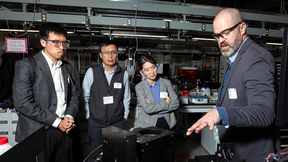
LLNL hosts Early Career Information Day focused on advanced materials and manufacturing
The University of California (UC) and Lawrence Livermore National Laboratory (LLNL) have a storied history going back to the founding of the Laboratory in 1952. The work conducted at the Lab since that time has benefited in many areas from successful collaboration with researchers and contributors within the UC system. In the spirit of continued collaboration, a UC Early…
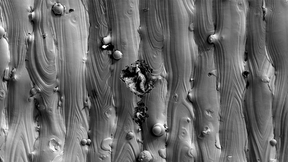
LLNL researchers uncover culprits behind pitting corrosion in 3D-printed stainless steel
Like a hidden enemy, pitting corrosion attacks metal surfaces, making it difficult to detect and control. This type of corrosion, primarily caused by prolonged contact with seawater in nature, is especially problematic for naval vessels. In a recent paper published in Nature Communications, Lawrence Livermore National Laboratory (LLNL) scientists delved into the mysterious…
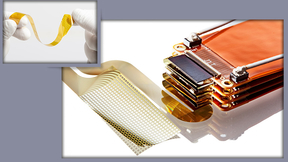
LLNL and Precision Neuroscience collaboration aims to develop next-generation neural implants
Lawrence Livermore National Laboratory (LLNL) has joined forces with Precision Neuroscience Corporation (Precision) to advance the technology of neural implants for patients suffering from a variety of neurological disorders, including stroke, spinal cord injury and neurodegenerative diseases such as Lou Gehrig's disease. Under the three-year collaboration, outlined in a…

New study reveals surprising behavior of iron under extreme conditions
Iron is one of the world’s most abundant elements and a primary component of the Earth's core. Understanding the behavior of iron under extreme conditions, such as ultra-high pressures and temperatures, has implications for the science of geology and the Earth’s evolution. In a study conducted by a team led by Lawrence Livermore National Laboratory. researchers combined…
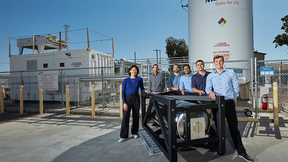
Hydrogen storage demonstrated for semi trucks
Lawrence Livermore National Laboratory (LLNL) and Verne, a San Francisco-based startup, have demonstrated a cryo-compressed hydrogen storage system of suitable scale for heavy-duty vehicles. This is the first time cryo-compressed hydrogen storage has been demonstrated at a scale large enough to be useful for semi trucks, a milestone in high-density hydrogen storage…